What the Live Nation settlement leaves out for independent venues
The Live Nation settlement covers 8,000 seat venues and leaves out festivals. What AEG, SeatGeek and NIVA told the court, and what independents should watch.
The public comment period on the US Justice Department's settlement with Live Nation closed on 4 September. In the last days before it closed, AEG, SeatGeek and the National Independent Venue Association (NIVA) all asked Judge Arun Subramanian not to approve the deal as it stands, and 18 attorneys general who are plaintiffs in the case filed their own comments.
The attention has gone to the big question of whether Ticketmaster should be sold. For anyone running a club, a theatre, a festival or an independent promotions company, the more useful part of these filings is narrower. They set out, clause by clause, which parts of the live business the settlement actually touches. Much of the independent sector sits outside it.
What the settlement does
Live Nation settled with the Justice Department in March, a week into the trial. It agreed to give up exclusive booking agreements at 13 amphitheatres, to let competing promoters work its amphitheatres and decide how to distribute up to half of the tickets, and to cap ticket service fees at those shows at 15%. It set aside $280 million for the states' damages claims and accepted an eight year extension of its consent decree.
Most states rejected the deal and carried on. In April a jury found that Ticketmaster unlawfully maintains a monopoly in ticketing services at major concert venues, and that Live Nation holds a monopoly in large amphitheatres and unlawfully requires artists who play them to use its promotion services.
The settlement has not been approved yet. Under the Tunney Act, the judge has to decide whether it serves the public interest, and the Justice Department must answer every comment and file them with the court before he rules.
The line is drawn at 8,000 seats
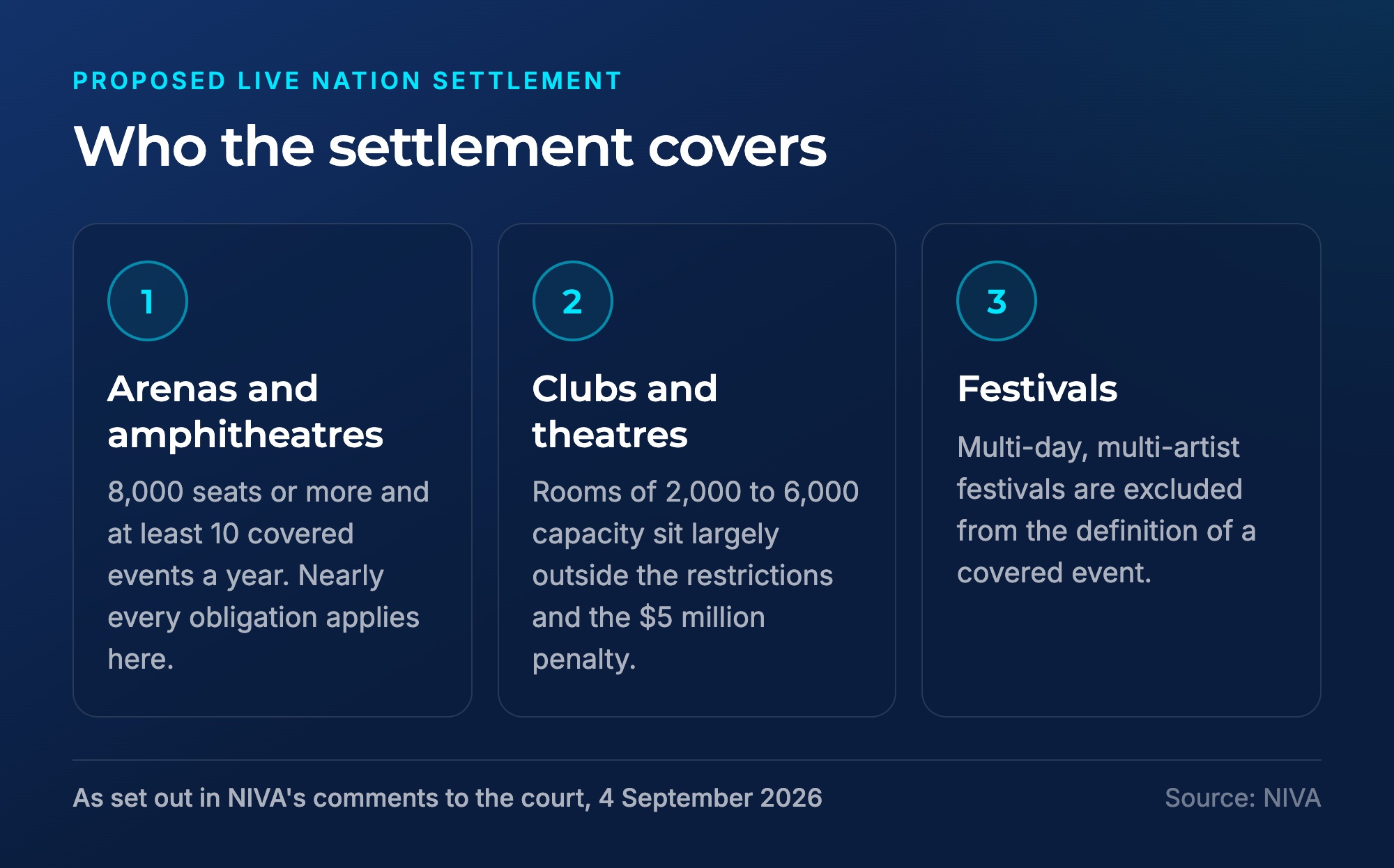
Almost every obligation in the settlement is tied to the term "Major Concert Venue", which it defines as an arena or amphitheatre with at least 8,000 seats that hosts at least 10 covered events a year. NIVA's filing points out that Live Nation has been opening clubs and theatres of 2,000 to 6,000 capacity in cities including Milwaukee, Pittsburgh, Nashville, Tampa, San Diego and Salt Lake City, and that none of those rooms fall under the settlement.
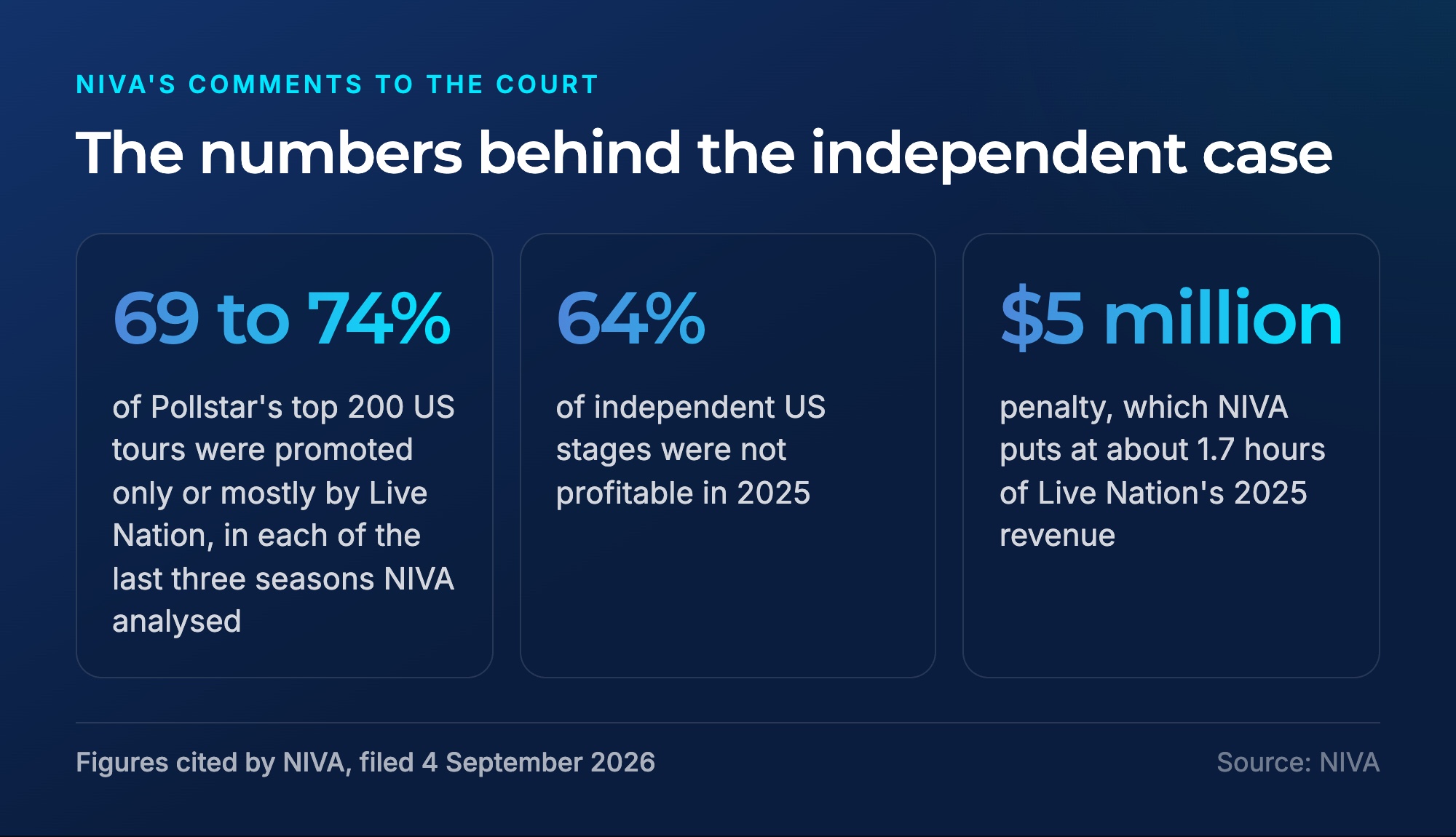
Penalties follow the same line. NIVA says the $5 million penalty for certain violations applies only to cases involving major concert venues, and that it could find no penalty schedule for anything else. It works that $5 million out at about 1.7 hours of Live Nation's global revenue, which was $25.3 billion in 2025.
NIVA goes further and argues that the jury's ticketing verdict covered venues of every size. TicketNews, reporting on the filing, pushed back on that: the ticketing markets argued at trial were built around major concert venues, even though the 8,000 figure itself comes from the settlement. Either way, many of the buildings NIVA represents are below the cut-off.
Festivals are outside the definitions
The settlement's rules apply to a "Live Entertainment Event", and that definition excludes any multi-day, multi-artist festival. NIVA spells out what follows. Withholding a festival slot from a venue that picked a rival ticketer does not count as retaliation. A company that only produces festivals is not a promoter under the settlement's definitions, so Live Nation could buy one of any size without giving the notice it would otherwise have to give for an acquisition.
Radius clauses are not mentioned at all, even though the complaint's allegations about them concern festival restrictions that keep artists off independent stages for months around the festival date.
Rivals get access through Ticketmaster's own system
The settlement's answer to exclusive ticketing contracts is what it calls open distribution. Rival marketplaces can sell tickets for covered venues, but they plug into Ticketmaster's back-end software, which Ticketmaster continues to run. NIVA notes that the agreement has no technical specifications, no API standard and no requirement on uptime or speed. "It is an access remedy in which the monopolist is the point of access," its filing says.
AEG, which competes with Live Nation in promotion and ticketing, was blunter: the settlement "does not break Ticketmaster's grip; it tightens it". On AEG's reading of the terms, Ticketmaster keeps about 6,500 of the 7,500 events a year at major concert venues, and only around 170 events open up to rivals.
SeatGeek's filing explains why venues do not simply switch. It says it has offered "retaliation insurance" to at least eight major concert venues, absorbing some of the risk of losing Live Nation shows, and paid the Florida Panthers nearly $1 million under one such clause this year. Virtually all of those venues stayed with Ticketmaster anyway, SeatGeek says.
Live Nation's position is that these are competitors arguing their own case. Its executive vice president Dan Wall told Music Business Worldwide that "much of what they say misrepresents the settlement's terms", and that the company is confident the court will approve it.
Whoever books the tour sets the price
NIVA's most unusual proposal has nothing to do with ticketing. It wants Live Nation barred from promoting more than half of the US dates on any headline artist's tour in a calendar year. Its reasoning is in one sentence of the filing: "The entity that books a tour determines the price for the shows on it."
To support that, NIVA reviewed Pollstar's top 200 US tours. In each of the last three seasons it looked at, tours promoted only by Live Nation, or with most of their dates booked by it, made up between 69% and 74% of the list. NIVA's argument is that a venue relying on Live Nation tours for its programme may feel pressure to accept Live Nation's ticketing or other commercial terms, whatever happens to Ticketmaster.
Louis Messina, whose company has promoted tours for Taylor Swift and Ed Sheeran, filed alongside AEG and made a related point about where the money is: "Live Nation does not make its money by promoting tours and helping artists. Instead, Live Nation makes its money from ticketing fees and sponsorships."
What independents should do with this
The judge may approve the deal or reject it, and the states that won in April are pursuing their own remedies separately. I would not plan a venue's next two years around the outcome.
What the filings make plain is that this settlement was written around arenas and amphitheatres. NIVA says 64% of independent US stages were not profitable in 2025. A room under 6,000 capacity that relies on routed tours for its busiest nights is exposed whichever way the judge goes, because I don't expect any version of this case to decide which rooms a tour plays.
The nights that are safest are the ones a venue or promoter programmes and sells itself, to an audience it knows how to reach. That is the problem we work on at Krowded: we find people on Instagram who fit an event and send each one a personal invite from the organiser's own account. I think the independents that come through this best, whatever the court decides, will be the ones who can fill a room without waiting for someone else's tour.
FAQ
What is the Live Nation settlement with the Justice Department?
Live Nation settled the Justice Department's antitrust case in March 2026, a week into trial. It agreed to give up exclusive booking agreements at 13 amphitheatres, cap ticket service fees at 15% at its amphitheatre shows, let rival marketplaces sell tickets through Ticketmaster's system, fund $280 million for state damages claims and extend its consent decree by eight years. A judge still has to decide whether it serves the public interest.
Does the Live Nation settlement cover small venues?
Mostly not. Nearly every obligation is tied to "Major Concert Venues", defined as arenas and amphitheatres with at least 8,000 seats and at least 10 covered events a year. NIVA's filing says clubs and theatres below that size, including the 2,000 to 6,000 capacity rooms Live Nation has been opening, sit largely outside the settlement's restrictions and its penalty schedule.
Does the Live Nation settlement cover festivals?
Largely not. The settlement defines a "Live Entertainment Event" in a way that excludes multi-day, multi-artist festivals, so its rules on retaliation, acquisitions and competition do not reach them. NIVA also notes that radius clauses, which stop festival artists playing nearby venues for months around the event, are not mentioned, even though they featured in the government's complaint.
What happens next in the Live Nation case?
The public comment period closed on 4 September 2026. The Justice Department must respond to every comment and file them with the court, and then Judge Arun Subramanian decides whether to approve the settlement. Separately, the states that refused to settle won a jury verdict in April and are pursuing their own remedies, which could go further than the federal deal.
Sources
- NIVA: Comments on the proposed settlement in United States v. Live Nation Entertainment (PDF, 4 September 2026)
- TicketNews: NIVA Calls for Ticketmaster Breakup, 50% Cap on Live Nation Tour Control
- Music Business Worldwide: AEG and SeatGeek ask court to reject Live Nation's DOJ settlement
- NPR: Live Nation and Justice Department reach settlement in antitrust case
- New York Attorney General: Attorney General James and Coalition of States Win Trial Against Live Nation and Ticketmaster