Britain's night time economy lost 28.7% of venues. The peak hour moved
Britain has lost 28.7% of its late night venues since March 2020, and 5pm to 7pm now takes more of the trade than 7pm to 10pm. What that means for events.
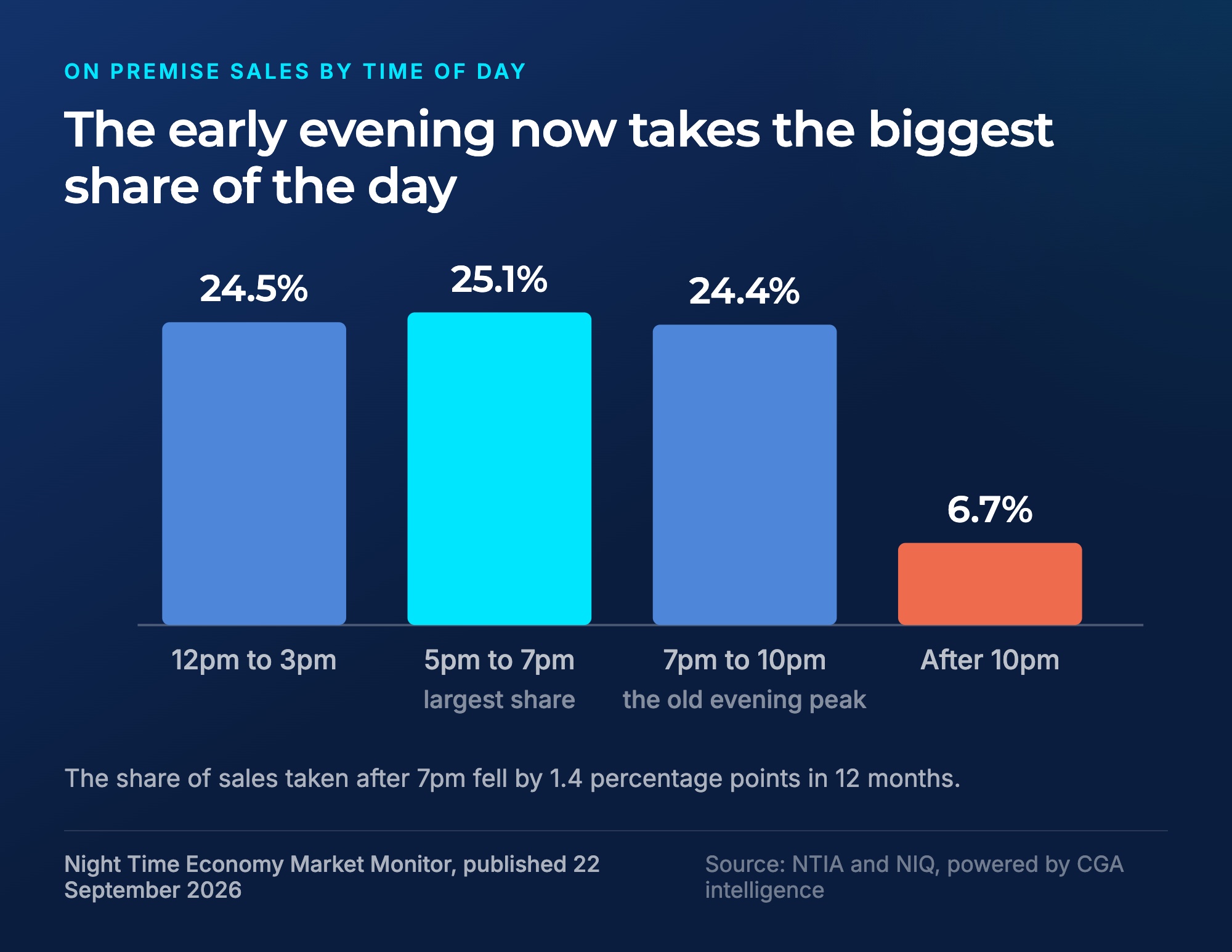
More of Britain's licensed hospitality spending now lands between 5pm and 7pm than between 7pm and 10pm. That comes from the Night Time Economy Market Monitor published on 22 September by the Night Time Industries Association with NIQ, powered by CGA intelligence: the 5pm to 7pm window takes 25.1% of On Premise sales, against 24.4% for 7pm to 10pm. Lunchtime, at 24.5%, has also overtaken the old evening peak. After 10pm, 6.7% of sales are left.
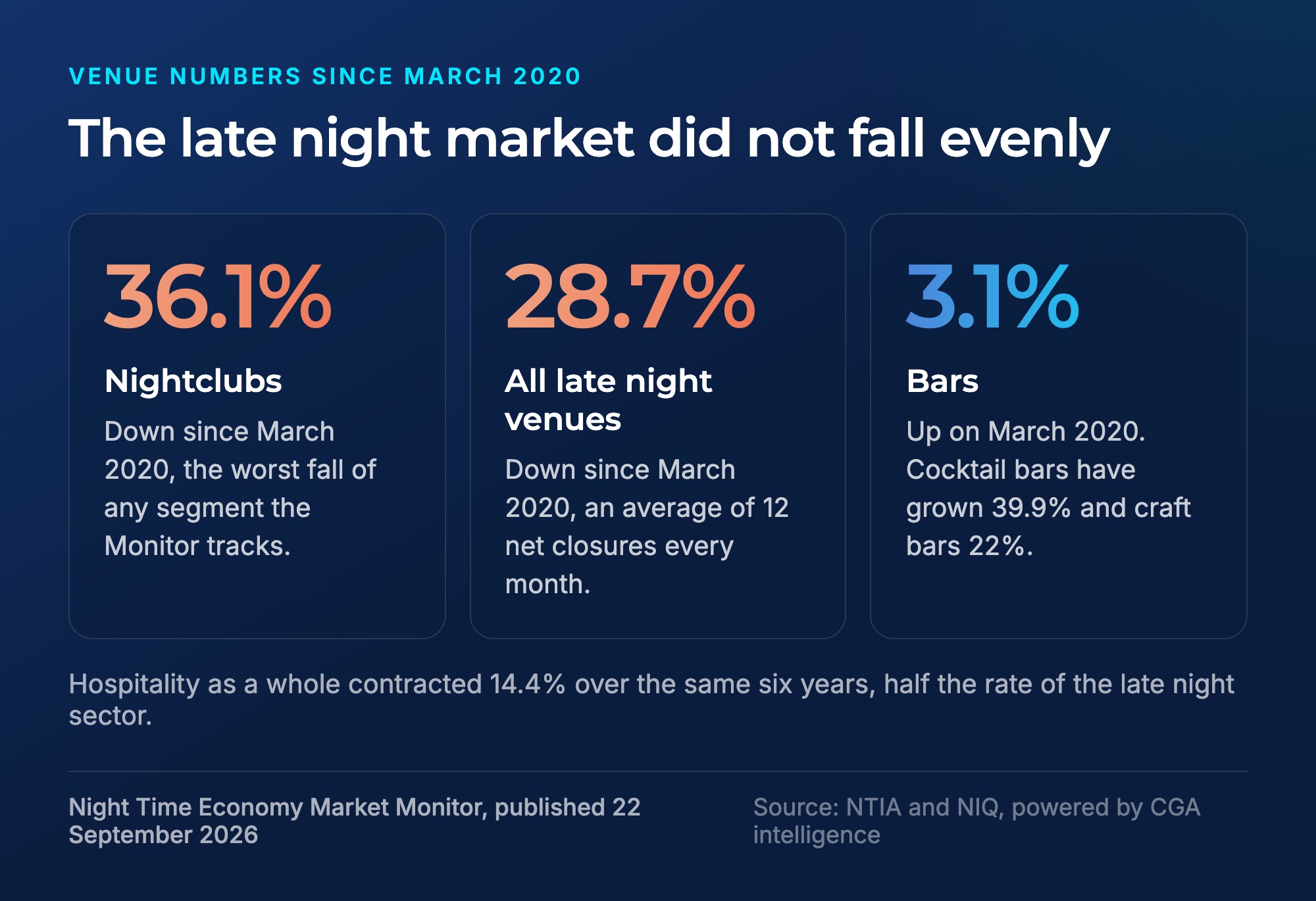
The same report carries the number everyone quoted instead. Britain has lost 28.7% of its late night venues since March 2020, an average of 12 net closures every month, and nightclubs are down 36.1%. On its own that reads as an audience walking away. Put next to the trading hours, it reads as something more awkward for anyone who programmes a room: the crowd is still going out, and it is arriving at an hour most late night venues were never built around.
Nightclubs fell hardest while bars grew
The headline figure covers late night venues as a group, and underneath it the segments have gone in opposite directions. Nightclubs are down 36.1% on March 2020, the worst performance of any segment the Monitor tracks. Bars are 3.1% above their March 2020 numbers. Cocktail bars have grown 39.9% since then, craft bars 22%, and themed bars 290.8% from a much smaller base.
Churn explains the rest. Only 48% of the late night venues trading before Covid are still there unchanged. 38% have left the market and 14% are new arrivals. Of the 4,695 bars trading at the end of June, 515 had opened in the previous 12 months, roughly one in nine.
Hospitality as a whole contracted 14.4% over the same six years, half the rate of the late night sector. So the pattern is a market being rebuilt around a different kind of room, by operators who are still willing to sign a lease.
The money moved into the early evening
In 12 months, the share of On Premise sales taken after 7pm fell by 1.4 percentage points. NIQ's own reading of the year puts consumer behaviour behind it: its High Tempo Report found 28% of consumers are going out earlier than they used to.
A percentage point of sales moving an hour earlier changes when a bar makes its money and how long the rota has to run to earn it. A room whose economics assume a 10pm surge is now competing for a share of trade that has fallen to 6.7% of the day.
It changes something different for a promoter. The set of people who will commit to a 7pm start in a city centre is a different set from the one that will commit to a 1am start. Moving a start time is a decision about which audience you are asking, as much as it is a licensing decision.
Travel and safety are why people come earlier
The Monitor asked people going out earlier why. 30% cited travel issues and 27% cited safety. Both are conditions around the venue that the venue does not control, which makes them a different problem from waning interest, and one with different answers.
Mike Kill, chief executive of the NTIA, said in NIQ's analysis of an earlier edition of the Monitor that "inconsistent approaches to licensing, transport and policing are undermining the infrastructure that a thriving night time economy needs", and that "demand is changing rather than disappearing". A room that reads the closures as lost interest will cut its programme. A room that reads them as a transport and confidence problem will move its doors, or give people a reason to travel that holds up at the hour they are willing to come.
Where you are decides more than it used to
The map has pulled apart. Liverpool and Newcastle sit 5.5% below their pre-Covid venue numbers. The North East as a whole is 10.5% smaller than in March 2020, against a national night time economy contraction of 14%. Greater London has lost 15.5% of its night time economy venues and Wales 17.9%.
Within London the split is sharper still. NIQ's 2025 figures show late night venue numbers in London's Central Activities Zone rose 2.7% across the year while Greater London contracted 7.0%, which it attributes to spending power, better after dark transport and the return of office workers and tourists.
The NTIA credits sustained public investment in the night time life of some northern cities for the gap, and argues the same approach would work elsewhere. For anyone planning a tour, a residency or a series of nights, it is a reminder that the national figure is not the figure you are trading against.
What October's Budget can reach
Late night venue numbers rose 0.4% between March and June 2026, the first increase after six years of decline, though the sector is still 3.1% down year on year. The NTIA is asking the government to act on taxation and operating costs in October's Budget, alongside investment in transport, safety and late night infrastructure, with the Golden Quarter immediately ahead.
Kill put the stakes plainly: "Get the conditions right and this fragile 0.4% growth could mark the beginning of sustained recovery into 2027. Get them wrong and the first green shoots we have seen in years could disappear before Christmas."
NIQ, with MAKE and Severnpools Consulting, put night time cultural spending at £43bn across a sector employing more than 2 million people, which shed an estimated 74,000 jobs between the start of 2024 and autumn 2025. Even a good Budget, though, works on the cost base. It leaves the hour at which people are willing to be in your room exactly where the trading data found it.
What this changes for anyone filling a night
The two halves of this report point at different decisions. The cost side is a lobbying question, and mostly out of an operator's hands until October. The hours are already in them. Door times, set times, what the first two hours of a night are actually for, and who gets asked to come are all choices that can be made this month.
The last of those is the hard one. If the early evening is where the trade now is, filling it means reaching people who were never going to see a 1am flyer, and giving them a specific reason to be somewhere on a specific evening. That is the problem Krowded works on: it finds people on Instagram who fit an event and sends each one a personal invite from the organiser's own account. On the report's own numbers the audience is still out there, at an hour that now has to be programmed for rather than assumed.
FAQ
How much of Britain's night time economy has closed since 2020?
Britain has lost 28.7% of its late night venues since March 2020, according to the Night Time Economy Market Monitor published in September 2026 by the NTIA and NIQ. That works out at an average of 12 net closures every month. Nightclubs have fallen furthest at 36.1%. Hospitality as a whole contracted 14.4% over the same period, so late night venues closed at roughly twice the rate of the wider sector.
Is nightlife demand falling or just moving?
The Monitor points to movement. Bars are 3.1% above their March 2020 numbers, cocktail bars have grown 39.9% and themed bars 290.8% from a smaller base, while nightclubs are down 36.1%. Trading hours have shifted too, with 5pm to 7pm now taking a larger share of On Premise sales than 7pm to 10pm. Both the formats people pick and the hours they pick them in have changed.
Why are people going out earlier in the evening?
Among consumers who say they go out earlier than they used to, 30% cite travel issues and 27% cite safety, according to the Market Monitor. NIQ's High Tempo Report found 28% of consumers going out earlier overall. Both reasons are about the conditions around a night out, which is why the NTIA is asking for investment in transport, policing and late night infrastructure alongside any tax relief.
Which parts of Britain have held up best?
Liverpool and Newcastle are only 5.5% below their pre-Covid venue numbers, and the North East as a whole is 10.5% smaller against a 14% national contraction. Greater London is down 15.5% and Wales 17.9%. Central London is an exception within its own region: venue numbers in the Central Activities Zone rose 2.7% during 2025 while Greater London fell 7.0%.
Sources
- Night Time Industries Association: 28.7% Of Night Time Economy Gone, October Budget Could Define The Future Of Britain's Nightlife
- NIQ: Hospitality and the Night Time Economy, the state of play in 2026
- NIQ: Almost three late-night hospitality closures every week, in last six years of pressure
- The Morning Advertiser: NTIA calls for Budget action to protect UK nightlife