$250m went into finding audiences. 475 UK venues have no promoter
Fever raised $250m for live events audience discovery, while 59% of UK grassroots venues carry no major promoter activity. What that says about reach.
On 17 September, Fever raised $250 million for the business of telling people what is on. EQT led the round, Point72 Private Investments and Baillie Gifford took part, and Fever described it as the largest financing round ever raised by a live entertainment technology company. Fever owns DICE, the UK ticketing platform whose acquisition passed its first anniversary this year.
The sector those tickets are sold for looks nothing like that. The Music Venue Trust's 2025 annual report puts the average British grassroots music venue on a cash surplus of £30,393 for the year, with 53.8% of venues reporting no profit at all.
So the money in live events has just put a record price on the layer that decides who hears about a show, while the rooms staging the shows run on a 2.5% margin.
What the largest round in the category bought
Fever says the money will take it beyond the 55 countries it operates in today, deepen its presence across the main entertainment categories, and go into technology and tools for its partners, a list that runs from promoters and venues to sports teams, attractions, artists, museums and cultural institutions. The company's statement describes three years in which it more than tripled its revenue, stayed EBITDA-positive and strengthened its position across North America and Asia. Fever also says that during 2025 its platform led more than 300 million people to discover live entertainment and cultural experiences.
EQT is a Stockholm-headquartered investment group that Fever calls Europe's largest private markets investor, and which reported €341 billion in total assets under management as of 30 June 2026.
The valuation attached to all this needs care, because the headline figure has moved around. Fever's own announcement carried no updated valuation. The roughly $5.2 billion number in circulation comes from Atresmedia selling its stake of just over 5% to Vitruvian Partners for about €227 million, which implies a company value near €4.5 billion, according to Cinco Días and Europa Press. Fever's last company-confirmed valuation was $1.8 billion in 2023, after a $110 million round led by Goldman Sachs. Goldman had also led a $227 million round in 2022, which Fever called at the time the largest ever for a live entertainment tech startup. Each record round has bought a position between an event and the person who might go to it.
The rooms on the other side of the ticket
The Music Venue Trust counted 801 trading grassroots music venues in 2025, down from 810 the year before, a fall of 1.2% and the slowest annual decline since 2018. Sector turnover rose 6.3% to £558,525,252.
The margins underneath are thin. The average venue turned over £697,284 and spent £688,140, which left a cash surplus of £30,393 and a profit margin of 2.5%. More than half the network, 53.8%, finished the year with no profit.
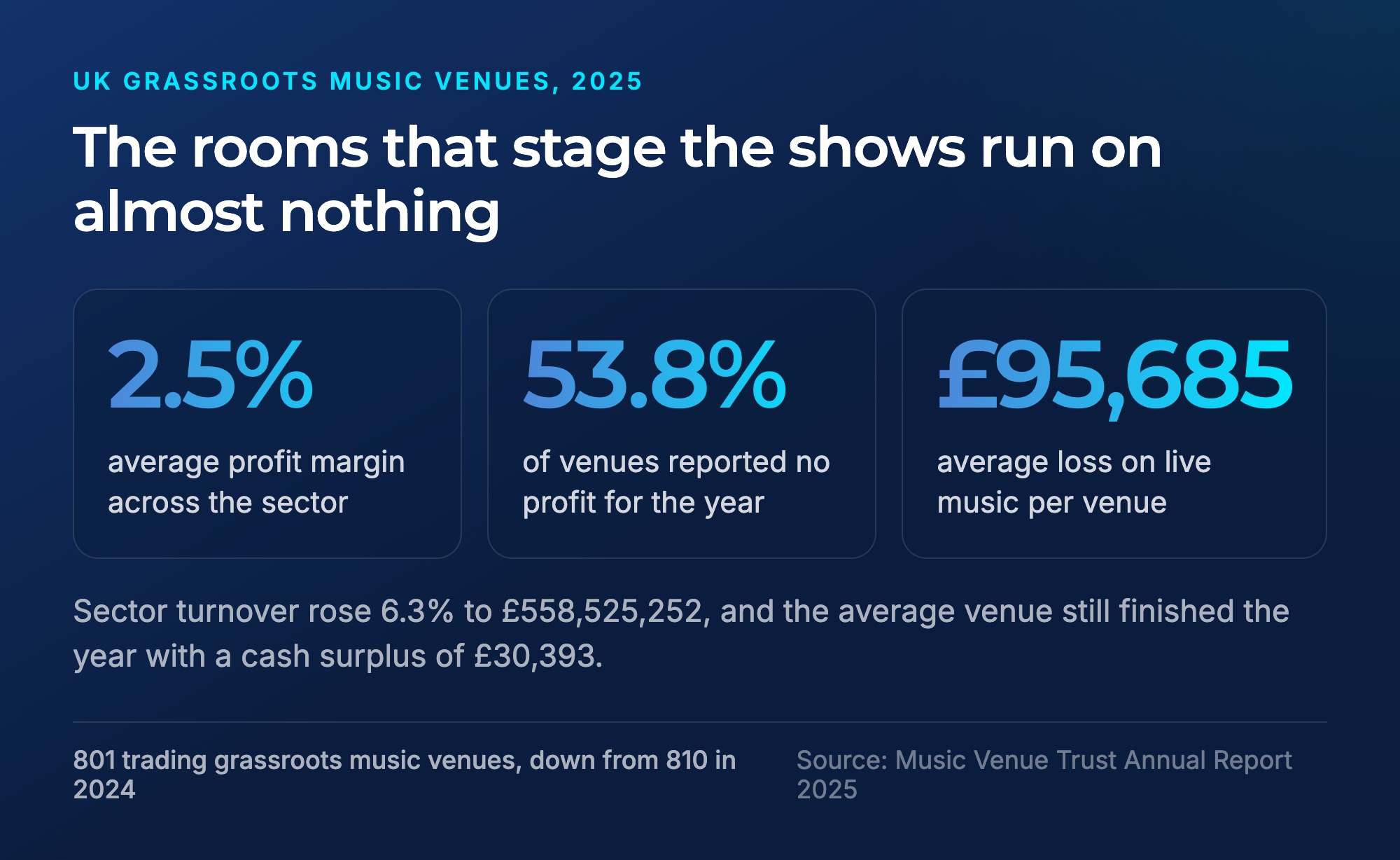
Live music itself loses money at venue level. Across the sector, income from live music came to £179,220,581 against expenditure of £255,864,260, so the network subsidised live music by £76,643,679, an average loss of £95,685 per venue. The bar, the room hire and everything else pays for the gig.
Costs did the rest. Employment across the sector fell from 30,865 people to 24,742, a decline of 19.8%. Business rates relief in England dropped from 75% to 40% in April, which together with the rise in Employer National Insurance lifted the sector's pre-profit tax burden by an estimated £7 million.
475 venues with nobody booking them
59% of grassroots venues, 475 rooms, now operate with no major promoter activity at all. The Trust's reading is that national tours no longer visit them, and that local promoters do not have the resources to fill the gap.
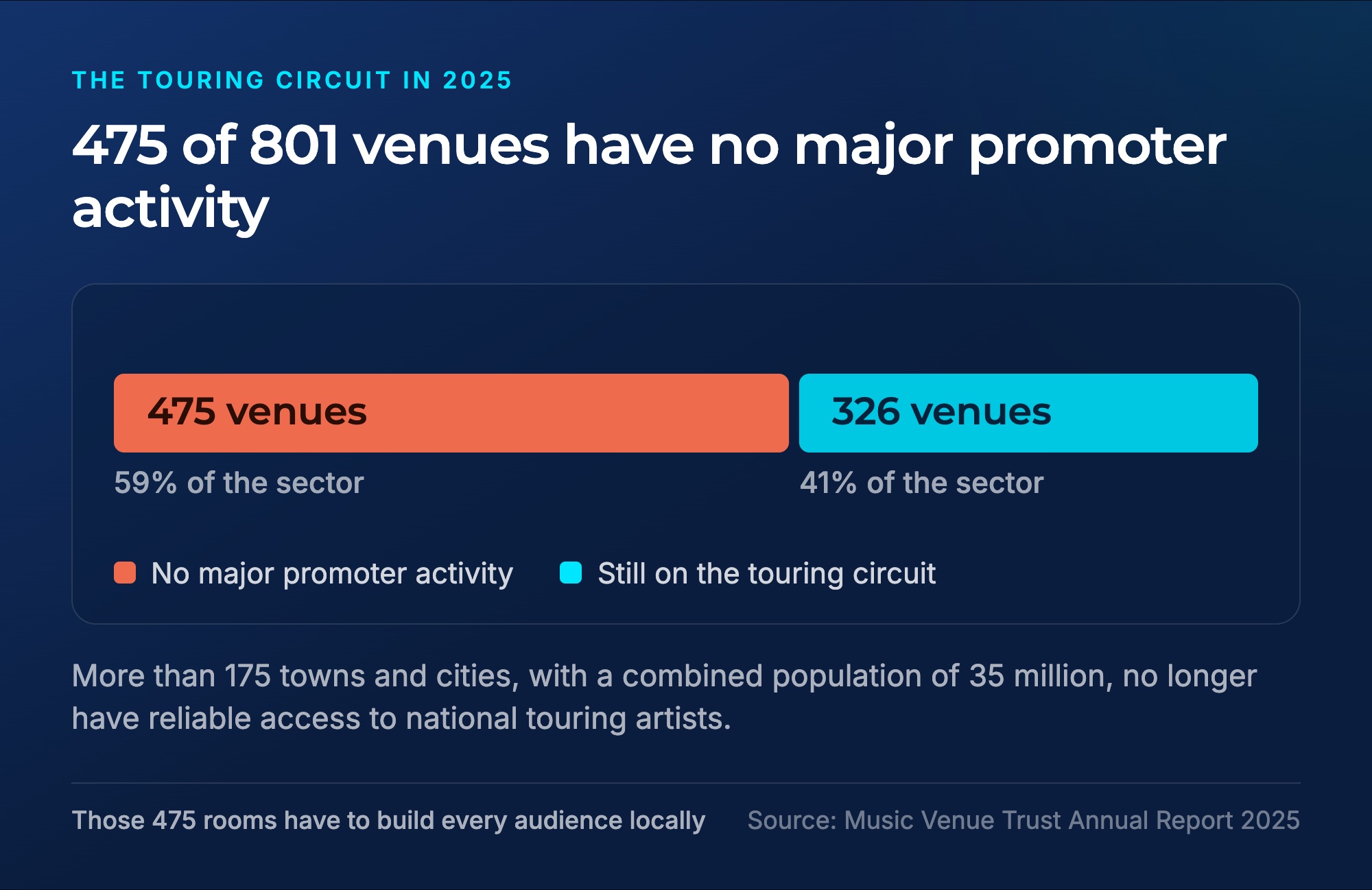
The geography has hardened around that. More than 175 towns and cities with a combined population of 35 million no longer have reliable access to national touring artists. The primary and secondary touring circuits sit largely in London, Manchester, Birmingham, Bristol, Glasgow, Leeds, Liverpool and Sheffield. Leicester, Hull, Portsmouth, Plymouth, Stoke, Newport and whole regions of Wales, Scotland and the South West have gone quiet.
For those 475 rooms, nobody arrives with an audience attached. Every night has to be built out of the people who live nearby, which makes audience reach the central operating problem rather than a marketing afterthought.
Supply of events was never the shortage
A 2.5% margin can read like a programming problem, the sort of thing a better booking policy would fix. The activity figures do not support that. Grassroots venues put on 174,552 events in 2025, of which 95,696 were ticketed live music events, and drew 21,683,552 audience visits. The average ticket price barely moved, from £11.48 to £11.56, as operators held prices to protect attendance.
Only 32.1% of grassroots venue income came from ticket sales. The other 67.9% came from everything else the building does, and in 2025 the share of venues opening as a bar or restaurant outside their live music hours went from 34.2% to 65.5%.
There is no shortage of events, then, and no shortage of rooms willing to host them. What is short is the match between a particular event and the particular people who would pay to be in the room for it.
The part of this an operator can own
The Trust's own split shows how much hangs on filling the room. Venues turning over less than £500,000 averaged a loss of 2.1%, while those above that line held positive margins of 3.4%. The difference between the two is attendance, and attendance is mostly a question of who heard about the night and believed it was meant for them.
Discovery platforms are worth money because they sit on that relationship. A venue listed on one is renting access to its own audience, on terms set elsewhere. Refusing the platforms would be daft when they bring people through the door. The useful move is to put a figure next to audience reach and manage it as a cost line, the way a room already budgets for sound hire, security and door staff.
The shift toward community ownership in the report, with 38.1% of venues now registered as not-for-profit, up from 33% in 2024, protects the building. It does not answer the question of who is inside it on a Thursday.
Where this leaves the next show you book
The largest cheque ever written in this category went to the layer that decides who hears about an event. None of it went to the rooms that stage them. That is a price put on audience reach by people with money at risk, and any operator who treats that reach as somebody else's product is accepting a 2.5% margin on a problem they could partly own.
Krowded works on the same problem from the organiser's side. It finds people on Instagram who fit a particular event and sends each one a personal invite from the organiser's own account, through a browser extension, so the invitation arrives from the room itself. There is more on why most venues need reach rather than rationing in an earlier piece, and you can talk to us if filling a specific room is the problem in front of you.
FAQ
Who led Fever's $250 million round?
EQT led the round, which was announced on 17 September 2026, with Point72 Private Investments and Baillie Gifford participating alongside other existing shareholders. Fever described it as the largest financing round ever raised by a live entertainment technology company. Fever's own announcement did not include an updated valuation, so the figures in circulation come from a reported secondary sale of Atresmedia's stake to Vitruvian Partners.
Why do so many grassroots music venues make no profit?
The Music Venue Trust found that 53.8% of UK grassroots venues reported no profit in 2025, with a sector average profit margin of 2.5%. Turnover rose 6.3% across the sector, but costs rose with it. Live music is loss-making at venue level, subsidised by £76,643,679 across the network, and the cut in business rates relief in England plus higher Employer National Insurance added an estimated £7 million to the sector's tax burden.
What does it mean that 475 UK venues have no major promoter activity?
It means 59% of grassroots venues sit outside the professional touring economy. National tours do not book them, and local promoters lack the resources to replace that supply. More than 175 towns and cities, home to 35 million people, no longer have reliable access to national touring artists. Those venues have to build each night's audience themselves, from the people who live within reach of the door.
Does an event discovery platform solve attendance for an independent promoter?
It helps, and it costs. A platform brings people who are browsing for something to do, which is real demand a single promoter cannot create alone. What it does not hand over is the relationship with those buyers, or any control of how your event ranks against everything else listed that night. Most operators need both: the platforms for passing trade, and a direct route to the people most likely to come.
Sources
- Music Business Worldwide: DICE owner Fever raises $250M led by EQT, at a $5.2B valuation, in largest ever round for a live-entertainment tech company
- Music Week: Fever raises $250m in equity financing, the largest amount ever for a live entertainment tech firm
- Pulse 2: Fever Raises $250 Million Led By EQT To Expand Global Live Entertainment Platform
- Music Venue Trust: Annual Report 2025 (PDF)