Ticket booking fees now sit inside your headline price
UK and US rules put ticket booking fees inside the advertised price. What that means for promoters, and what one festival's 75 cent fee does and does not show.
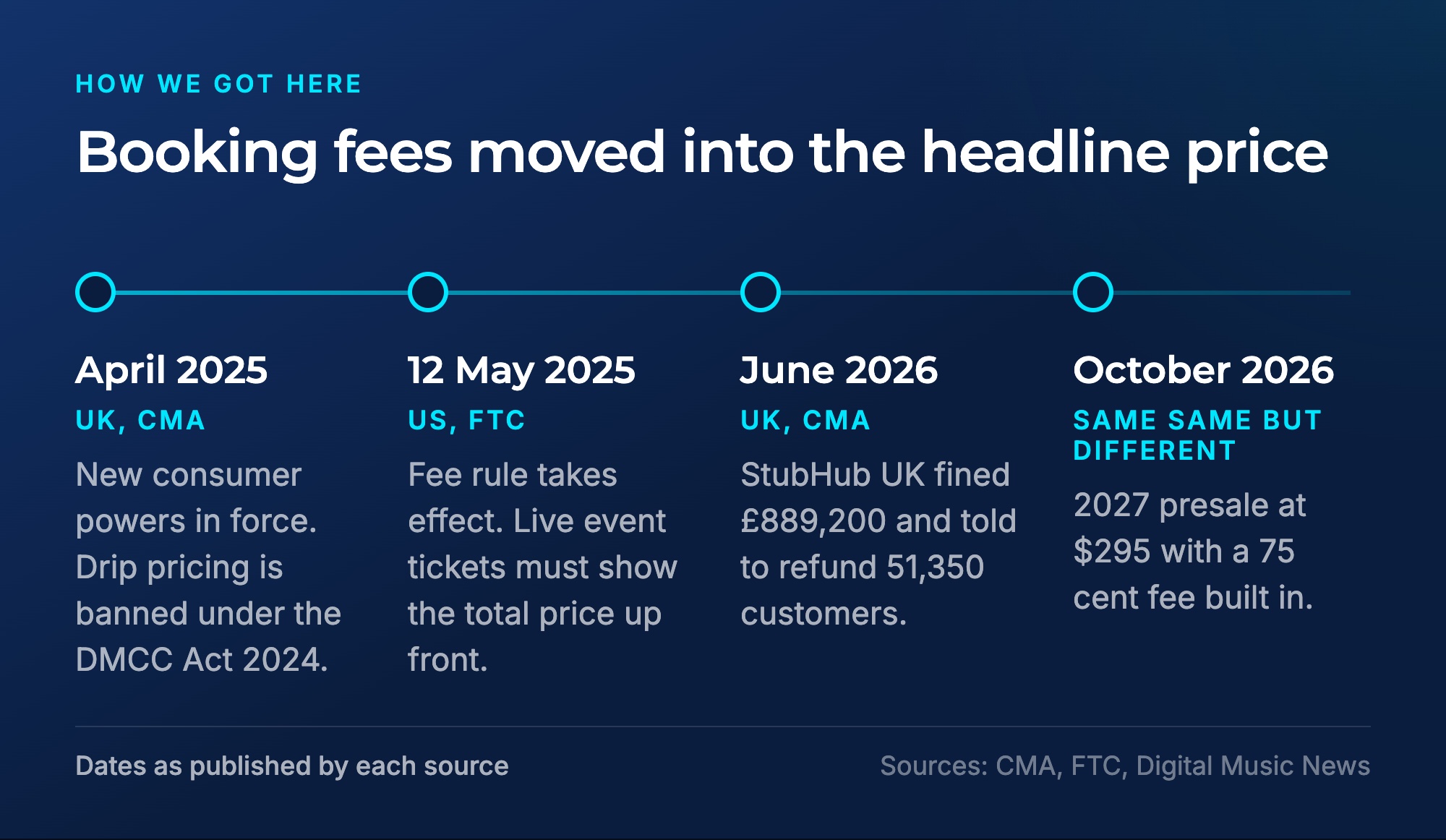
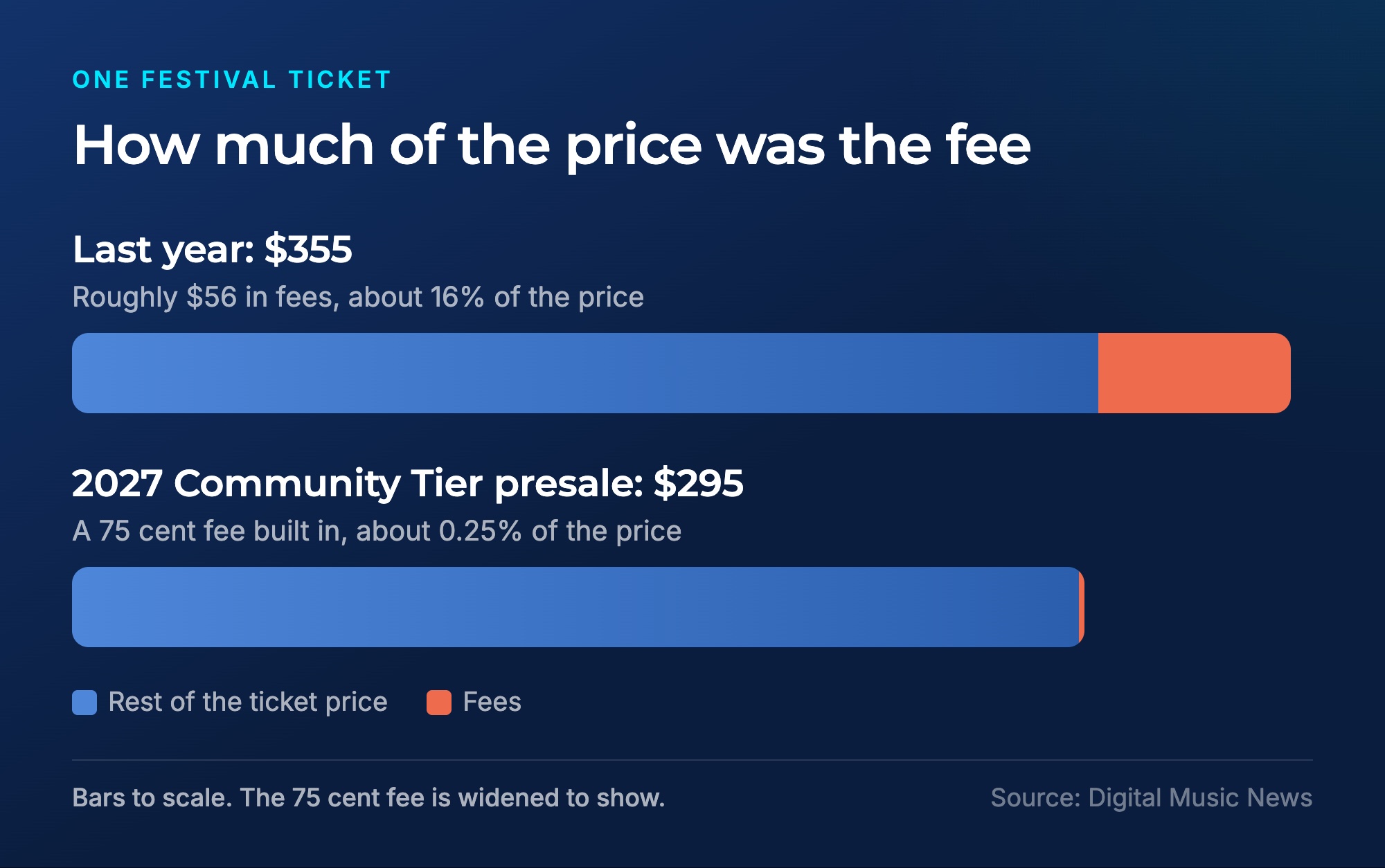
Last year a ticket to Same Same But Different, a 7,500 capacity festival at Lake Perris in California, cost $355, and roughly $56 of that was fees. The festival's 2027 Community Tier presale for general admission costs $295, with a 75 cent fee built in. The festival puts the difference down to a ticketing platform its own chief executive built on Shopify, according to Digital Music News.
One festival changing supplier would be a small story on its own. It matters more because of the law around it. In the UK since April 2025, and in the US since May 2025, a booking fee that every buyer has to pay must be inside the first price the buyer sees. Once the fee is part of the advertised price, what a promoter pays for ticketing stops being a line the fan meets at checkout. It becomes part of the number the promoter competes on.
The rules on both sides of the Atlantic
In the UK, the Digital Markets, Competition and Consumers Act 2024 bans drip pricing, and the Competition and Markets Authority's consumer powers under it came into force in April 2025. The CMA's price transparency guidance (CMA209, November 2025) lists the mandatory charges a headline price has to include. The list names "administration fees, however described, such as booking or processing fees".
The same guidance goes further on suppliers. If a trader uses a third party to provide a service and wants to pass that cost on, consumers "have no way of opting out", so the charge belongs in the total price. A promoter's ticketing company fits that description closely. The fan does not pick the ticketing company, the promoter does.
In the US, the Federal Trade Commission's Rule on Unfair or Deceptive Fees took effect on 12 May 2025 and covers live event tickets. The FTC says the rule does not prohibit "any type or amount of fee". It requires the total price up front.
Neither regime caps fees. Both make them visible at the moment a buyer compares one event with another, which is the moment a promoter cares about most.
The UK regulator has already fined a ticket seller
When the CMA opened its first cases under the new powers in November 2025, it cited a Department for Business and Trade report finding drip pricing at 93% of event ticket businesses reviewed. Cinema tickets came in at 69% and gym memberships at 60%. Two of its eight investigations were into resale sites StubHub and viagogo.
In June 2026 the CMA fined StubHub UK £889,200 and ordered refunds of more than £590,000 to 51,350 customers. Between 6 April and 7 December 2025, it found, fans were charged mandatory delivery and service fees that appeared only at the last stage of checkout. StubHub UK admitted the breach and settled early, which cut its fine by 40%. The CMA can fine up to 10% of global turnover. Its consumer protection director, Emma Cochrane, put the message to businesses as "be transparent on costs or risk CMA action."
StubHub is a resale marketplace, but the guidance covers any trader advertising a price to consumers, not only resale sites. We covered how the same UK rules treat dynamic pricing in an earlier piece.
What the festival changed
The platform is ShopTickets, built by Same Same But Different's co-founder and chief executive Brad Sweet. It has been listed on the Shopify App Store since December, and the festival's 2026 tickets were still sold through Tixr. Its public pricing is a flat $1.50 per ticket on the free plan, or $0.75 per ticket on a $49 a month plan. Digital Music News reports it has no long-term contracts.
"Ticketing fees have gotten disconnected from the actual cost of selling a ticket," Sweet told Digital Music News.
On those numbers, last year's fee was about 16% of the ticket price and the new one is about a quarter of one per cent. The festival chose to pass the saving to fans as a lower price, which is a pricing decision as much as a ticketing one. With the fee inside the headline, the same saving could just as easily have stayed with the organiser as margin at the old price.
What the 75 cents does not show
The comparison is the festival's own, and a few things sit outside it.
The festival is not a typical customer of its platform. Its chief executive built ShopTickets, and the festival raised more than $690,000 on WeFunder last year by selling equity in it to fans. A promoter buying the same product would be buying from a supplier with its own margin to protect.
The 75 cents is ShopTickets' charge. Neither the listing nor the announcement says what card processing or the Shopify store itself costs the festival, or who staffs customer service and entry on the day.
Size matters too. A festival that caps sales at 7,500 can run its own box office in ways an arena tour cannot, and a venue tied into a multi year ticketing deal may not be free to switch at all. Our piece on the Live Nation settlement looks at how exclusive ticketing contracts were handled in that case.
Questions for your next ticketing contract
With the fee now part of the advertised price, a promoter weighing a ticketing deal can ask a sharper set of questions than before:
- Is the fee a flat amount per ticket or a percentage of the price, and how does that change at your top tier?
- Does any part of the fee come back to you, and would the fan see a lower price if it did not exist?
- How long does the contract run, and what does leaving early cost?
- Does the advertised price on your own site, the platform's listing page and every partner site already include every mandatory fee?
The last one is a compliance question as well as a commercial one. CMA209 says that when a product is listed on an online marketplace, both the marketplace and the trader selling through it may be held responsible for a price that breaks the rules.
Where this leaves promoters
All-in pricing turns the booking fee from the ticketing company's business into the promoter's. Every pound of fee is now a pound on the price a fan compares, so it is worth negotiating with the same care as an artist fee or a venue hire. Few organisers will build their own platform as Same Same But Different did. Most can still ask for a per ticket breakdown of the fee before they sign.
A lower fee only helps if the right people see the price in the first place. That part of the problem is the one we work on at Krowded: it finds people on Instagram who fit an event and sends each one a personal invite from the organiser's own account.
FAQ
Do UK ticket prices have to include booking fees?
Yes, where the fee is mandatory. Under the Digital Markets, Competition and Consumers Act 2024, the headline price in an invitation to purchase has to include charges every buyer must pay. The CMA's guidance (CMA209) names booking and processing fees, however they are described. Showing a fee separately or calling it an extra service does not make it optional, the guidance says. If the buyer has to pay it, it belongs in the first price they see.
What does the FTC fee rule mean for US concert tickets?
Since 12 May 2025, anyone advertising a price for a live event ticket in the US has to show the total price, including mandatory fees, clearly and up front. The FTC says the rule does not ban any type or amount of fee or any pricing strategy. It changes where the fee appears, so a promoter's ticketing costs now show up in the price a buyer compares across events.
Has anyone been fined for hidden ticket fees in the UK?
Yes. In June 2026 the Competition and Markets Authority fined StubHub UK £889,200 and ordered refunds of more than £590,000 to 51,350 customers. It found that mandatory delivery and service fees were added at the last stage of checkout between April and December 2025. StubHub UK admitted the breach and received a 40% reduction for settling early.
Can a festival run its own ticketing to cut fees?
It can. Same Same But Different moved its 2027 presale to ShopTickets, a Shopify based platform its chief executive built, and says its fee fell from roughly $56 to 75 cents a ticket. That figure is the platform's own charge. The announcement does not say what card processing, staff or the Shopify store cost the festival, and a promoter on a long ticketing contract may not be free to switch.
Sources
- Digital Music News: California Festival Slashes Ticketing Fees by 99% by Building Its Own Platform On Shopify
- Same Same But Different Festival: official site
- Shopify App Store: ShopTickets listing and pricing
- Federal Trade Commission: FTC Rule on Unfair or Deceptive Fees to Take Effect on May 12, 2025
- Competition and Markets Authority: Unfair commercial practices, price transparency (CMA209)
- Competition and Markets Authority: CMA launches major consumer protection drive focused on online pricing practices
- Competition and Markets Authority: CMA orders StubHub UK to refund customers over hidden fees