A presale is not resale: what AB 1349 means for independents
California's AB 1349 sits with Governor Newsom until the end of September. What the enrolled text says, why independent venues want a veto, and what it misses.
The enrolled text of California's AB 1349 defines a speculative ticket sale as one made "by a person other than a ticket resale marketplace". The bill was written to stop the sale of tickets nobody holds, and the sellers that definition covers are everyone except the websites where those listings appear. Resale marketplaces get a separate duty further down the same section. The venue, the promoter and the festival get the definition. That is most of the reason a bill about ghost tickets ended with the trade body for independent stages asking the Governor to kill it.
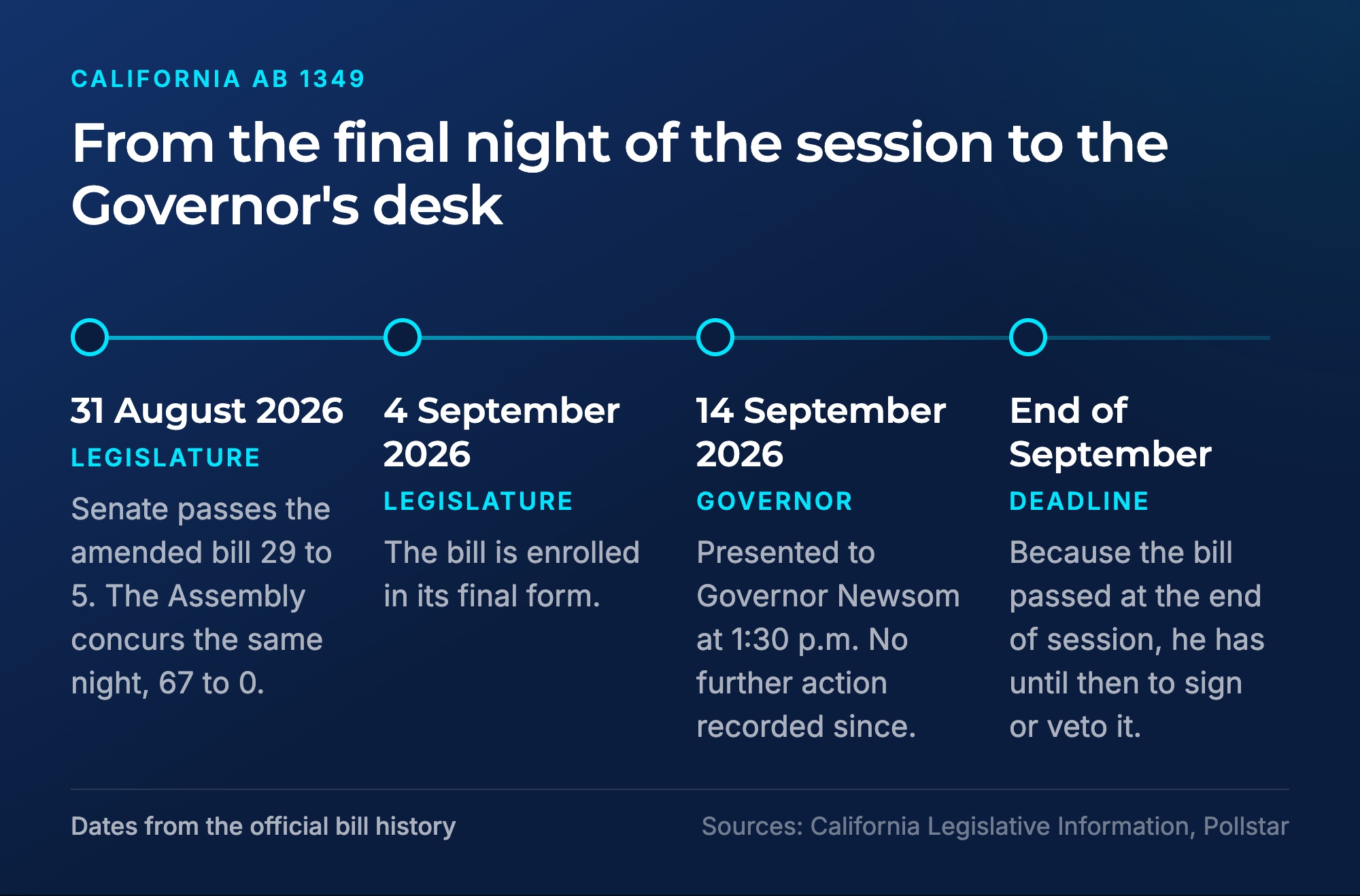
The Senate amended AB 1349 late on 28 August, passed it 29 to 5 on 31 August, and the Assembly concurred the same night 67 to 0. It was enrolled on 4 September and presented to the Governor on 14 September at 1:30 p.m. Because it passed at the end of the session, Pollstar reported that Newsom has until the end of September to sign or veto it rather than the usual twelve days. As of this week, the history shows no action after the presentation.
What the enrolled text actually does
The core prohibition is straightforward. A seller may not advertise, list, market or accept payment for a ticket without either actual or constructive possession of it, or authorisation from the event presenter or venue operator. Constructive possession is defined narrowly: fully paid for, a legally enforceable right to delivery, and confirmation of purchase or assignment.
Two details matter more to an independent operator than the headline.
The first is who counts as a seller. A "ticket seller" is any person who, for compensation, advertises, lists, markets, offers, facilitates the sale of, or sells an admission ticket. A room that sells its own shows is inside that definition, and subdivision (d) says a ticket seller may not market a ticket before the presenter, venue, rights holder or original seller has made it available, unless authorised or holding constructive possession.
The second is the remedy. Section 22502.3 makes a seller who breaches these provisions and fails to supply a ticket at or below the contracted price liable to the purchaser for twice the contracted price, plus any non-refundable money the buyer spent trying to attend, plus reasonable legal fees and court costs.
Then come the carve-outs. Season packages, multigame packages, playoff packages and "inventory withheld at the sole discretion of the rights holder or venue operator" sit outside the speculative sale section when a rights holder or authorised agent handles them before the season. A separate provision goes further and says nothing in the chapter imposes liability on a California-based professional sports team, a sports venue operator or a league-owned entity for withholding, reserving, managing, transferring or allocating inventory for operational or business purposes.
Why the people who helped write it want it stopped
In March, NIVA said it was "proud to help architect" AB 1349 alongside AB 1720, a companion bill that would have capped covered resales at 10% above the original price. AB 1720 was held by Senate Appropriations in August. By the final weekend, according to TicketNews, NIVA and 16 allied organisations were asking lawmakers to reject the bill they had backed for most of the session.
NIVA's objection is about where the exposure landed. Its statement says the bill creates a private right of action for speculative sales that reaches independent venues, festivals and presenters and not resale marketplaces, and that a venue running a presale, a waitlist or a VIP package can be treated as a reseller. "It puts the small businesses and nonprofits that put on shows every night at risk," said Stephen Parker, NIVA's executive director.
Not everyone reads it that way. The Coalition for Ticket Fairness, which opposed the bill earlier in the session and changed position after the Senate rewrite, called final passage a win. "California already has some of the strongest consumer protections in the country, and this bill goes further by cracking down on speculative ticket sales," spokesperson Geoff Vetter told TicketNews. Pollstar reported that the amendments followed a lobbying push in Sacramento from secondary sellers led by StubHub.
The question the bill never touches
Whichever way this goes, it decides who may list a ticket. It decides nothing about who shows up.
Demand for live music has not gone quiet while the lawyers argue. Luminate's U.S. Music 360 survey found Gen Z attendees spending a monthly average of $101 on live music in the first quarter of 2026, ahead of Millennials on $94. The share of Gen Z naming ticket cost as a barrier fell from 75% in the first quarter of 2024 to 57% two years later, and the share going to two concerts a year rose from 29% to 37% while single show attendance fell.
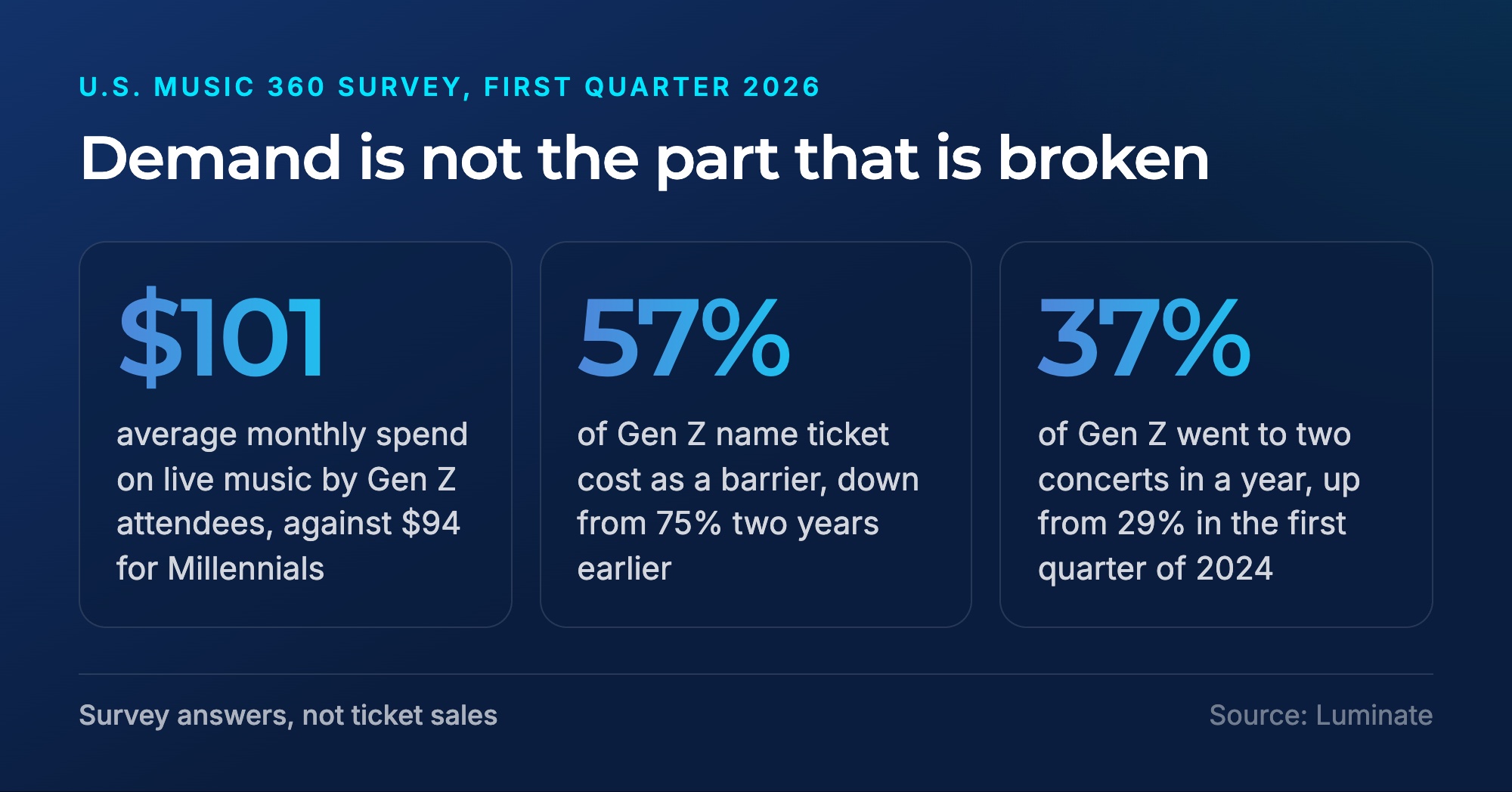
People are going out more often. Whether they come to a particular night still depends on whether they hear about it.
Keep a route to the audience that is yours
Presales, waitlists and announcements are the few tools an independent room has for reaching its own people before the open market does. Seeing them argued into the same legal category as resale shows how thin that ownership is when it runs through someone else's rules and someone else's inbox.
What an organiser actually controls is narrower: who hears about the night, and how personally. That is the problem Krowded works on. It finds people on Instagram who fit a specific event and sends each one a personal invite from the organiser's own account, through a browser extension. Nothing in Sacramento changes whether an organiser can speak directly to the people who would want to be there.
If you sell into California, read the enrolled text rather than a summary of it, and take subdivision (d) and the remedy in section 22502.3 to a lawyer before your next presale. Then look at the part no bill decides. We have written about the same split in the UK, where resale price caps and dynamic pricing are being settled above the heads of the rooms that carry the risk, and about what the Live Nation settlement leaves out for independents. The rules keep being written around the biggest sellers, and the rooms carrying the risk are left with whatever reach they built themselves.
FAQ
What is a speculative ticket sale under AB 1349?
The enrolled text defines it as advertising, listing, marketing, offering, accepting payment for or selling a ticket when the seller has neither actual nor constructive possession of it, nor authorisation from the event presenter or venue operator. Constructive possession requires full payment, a legally enforceable right to delivery and confirmation of the purchase or assignment. The definition applies to a person other than a ticket resale marketplace, which is given its own separate duty to prevent such listings on its platform.
Does AB 1349 ban presales?
The word presale does not appear in that prohibition. What the text says is that a ticket seller may not market a ticket before the presenter, venue, rights holder or original seller has made it available, unless the seller is authorised or has constructive possession. NIVA's reading is that a venue running a presale, a waitlist or a VIP package could be treated as a reseller and exposed to the bill's purchaser remedy. That question would be settled in court, not in the text.
When does Governor Newsom have to decide?
The bill was presented to him on 14 September 2026 at 1:30 p.m. Pollstar reported that because it passed at the end of the legislative session, he has until the end of September to sign or veto it rather than the standard twelve days. The bill history showed no action after the presentation at the time of writing.
Does any of this apply outside California?
Not directly. California law binds sales into California. It matters elsewhere because the same argument keeps recurring in different jurisdictions: rules aimed at resale are drafted broadly enough to catch the primary sale, and the largest sellers negotiate their own exemptions while independent rooms absorb the risk.
Sources
- California Legislative Information: AB-1349 Consumer protection: ticket sellers, enrolled text
- California Legislative Information: AB-1349 bill history
- National Independent Venue Association: NIVA calls on Governor Gavin Newsom to veto AB 1349
- Pollstar: California Legislature passes spec ticket ban, but NIVA and others call for veto
- TicketNews: California ticket bill survives last minute revolt from industry lobby, heads to Newsom
- Luminate: How Gen Z is shaping live music's future